



Snow Fountains® Weeping Cherry Tree
Prunusx yedoensis ‘Snofozam'
Mature Height: 8 to 12 ft.
Mature Spread: 6 to 10 ft.
Couldn't load pickup availability
Shipping
| Bloom Color: | White and pink |
| Bloom Period: | Early spring |
| Fall Color: | Orange, yellow, and golden |
| Foliage Color: | Green |
| Genus & Species: | Prunusx yedoensis ‘Snofozam' |
| Growth Rate: | Slow |
| Mature Height: | 8 to 12 ft. |
| Mature Spread: | 6 to 10 ft. |
| Soil Type: | Moist well-draining soil rich in organic matter |
| Sun Exposure: | Full sun |
| Zone: | 5 to 8 |
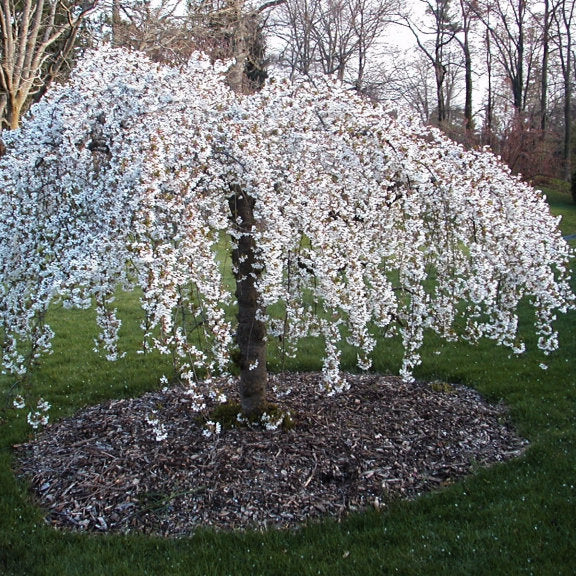
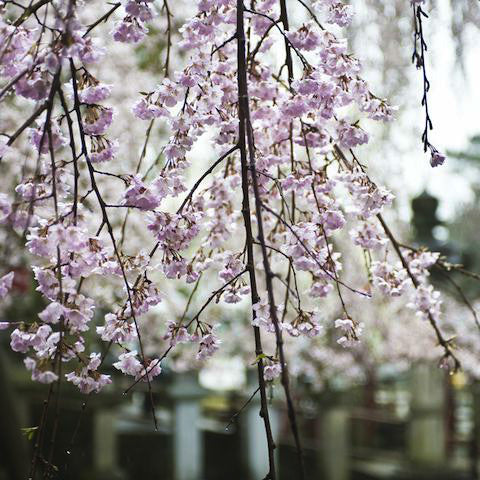
he Snow Fountain Cherry earns its name honestly—cascading branches sweep all the way to the ground, and when covered in pure white flowers in early spring, the tree creates the appearance of a frozen waterfall caught mid-cascade. Single white flowers emerge from pink buds in mid-spring, covering the bare branches for about three weeks before dark green leaves appear. This slow-growing weeping cherry reaches 8 to 15 feet tall with an equal spread, making it one of the more compact flowering cherries available. The dark green ovate leaves provide a fresh summer canopy before turning attractive shades of gold, yellow, and orange in fall. Small, sparse black fruits follow the flowers but aren't particularly ornamental.
Snow Fountain Cherry was introduced around 1985 by Lake County Nursery in Perry, Ohio, part of the prolific "ZAM" series of ornamental introductions from that breeding program [3]. The cultivar is a selection of Prunus × subhirtella, the Higan Cherry—a naturally occurring Japanese hybrid between Prunus itosakura (thread cherry) and Prunus incisa (Fuji cherry) [2]. Higan cherries generally live longer than most Japanese ornamental cherries and tolerate heat and cold better than many flowering cherries [2]. Hardy in zones 5 through 8, Snow Fountain performs best in full sun and moist, well-drained soils of average fertility, though it adapts to poorer soils and compacted conditions once established. The tree works beautifully as a specimen in small gardens, courtyard plantings, Japanese-inspired designs, or cascaded over garden walls.
The early spring flowers attract bees and other pollinators with nectar. The small black fruits, while sparse, provide food for birds in late summer. However, like most Asian ornamental cherries, Snow Fountain won't match the wildlife value of native North American Prunus species—native cherries like Prunus virginiana and Prunus serotina support hundreds of Lepidoptera species that are critical food sources for nesting songbirds, while Asian cherries support far fewer native insects [4]. The tree is susceptible to the typical Prunus problems including leaf spot, powdery mildew, borers, aphids, scale, and tent caterpillars, though it's generally considered relatively problem-free compared to other flowering cherries [1][2]. Plant Snow Fountain where its elegant weeping form and early spring display can be appreciated up close—near walkways, patios, or entryways where the cascading branches create a dramatic focal point.
[1] Missouri Botanical Garden.
[2] NC State Extension Gardener Plant Toolbox.
[3] Oregon State University Landscape Plants.
[4] NC State Extension Gardener Plant Toolbox.
General care for any tree or shrub is easy, but like any living thing will require your attention. Please educate yourself and follow these simple rules.